
Post-July Politics: Trajectory and Future Prospects
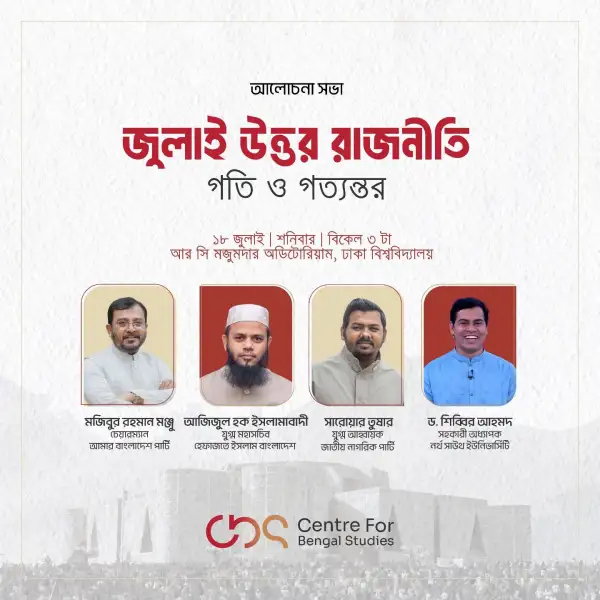
Discussion on “Post-July Politics: Trajectory and Future Prospects” Held
A discussion titled “Post-July Politics: Trajectory and Future Prospects” was held at the R. C. Majumdar Auditorium, University of Dhaka, under the auspices of the Centre for Bengal Studies (CBS). The event brought together academics, researchers, students, and representatives of various political parties, who called for preserving the spirit of the July uprising and for a united resistance against what they described as attempts to rehabilitate fascism.
The session was moderated by Farhad Hossain. Delivering the welcome address, Abdullah Al Mahmud, Director of the Centre for Bengal Studies, greeted the participants and outlined the objectives of the discussion.
Speaking at the event, Advocate Dr. Sazzad Hossain, a lawyer of the Supreme Court of Bangladesh, argued that there is an ongoing effort to erase the memory of July. He stated that certain senior journalists and public intellectuals attempt to deny the significance of the July movement through television talk shows and opinion pieces. According to him, such narratives should be challenged critically, adding that “the politics of denial will not endure in the new Bangladesh; it is the politics of the new generation that will keep the spirit of July alive.”
Sarwar Tushar, Joint Convener of the National Citizen Party (NCP), criticised the proposal for a Truth and Reconciliation Committee. He argued that the proposal effectively sought to facilitate the political rehabilitation of the Awami League through a process of “deny and rehabilitation.” He maintained that there is no precedent for rehabilitating a political party accused of mass killings and asserted that former Prime Minister Sheikh Hasina would neither have the courage to return to Bangladesh nor receive public acceptance if she did.
Researcher Dr. Shibbir Ahmed emphasised the need to dismantle what he described as the cultural and academic structures of authoritarianism. He argued that the Awami League had established a propaganda-driven cultural and academic framework that continues to influence public discourse. Drawing a comparison with post-war Germany’s denazification process, he suggested that Bangladesh should undertake a similar process of “de-Awamification.” According to him, the future of a new political order depends on strengthening the forces associated with the July movement rather than accommodating the Awami League.
Representing Hefazat-e-Islam Bangladesh, Joint Secretary General Azizul Haque Islamabadi stated that the original spirit of the July movement had been undermined in various ways. He recalled the participation of madrasa students and other activists who, in his view, risked their lives during the movement. Referring to reports that Sheikh Hasina might return to the country, he argued that she should instead face legal accountability for the deaths that occurred during her tenure, including the 5 May Shapla Chattar incident, for which he said he had personally filed a case. He concluded that the younger generation should lead the effort to realise the aspirations of a new Bangladesh.
Mujibur Rahman Manju, Chairman of the Amar Bangladesh (AB) Party, identified three major characteristics of the post-July political landscape: divisions among the forces behind the July movement, conflicts among those who emerged victorious, and efforts by defeated political actors to regain influence. He stressed the importance of maintaining unity among the victorious forces despite disagreements over state reforms and governance. He also warned that if the Bangladesh Nationalist Party (BNP) were to adopt political strategies similar to those of the Awami League on issues such as state reform, a referendum, and implementation of the July Charter, it should expect resistance from the younger generation, whom he described as having mobilised against the previous political order.
The discussion concluded with an open question-and-answer session in which teachers, students, and politically engaged members of the audience exchanged views with the speakers.
Event Details
18 July, 2026
3:00 PM
RC Majumdar Auditorium, DU
Seminar