
The Spread of Islam in Bengal: The Possible Impact of Agriculture and the Environment
Wet Rice Cultivation and Environmental Change May Have Shaped the Spread of Islam in Bengal
The introduction of wet rice cultivation in medieval Bengal doubled, and in some cases even tripled, rice production. To capitalize on this dramatic increase in agricultural productivity, large tracts of forest were cleared under the leadership of Muslim Sufi saints (pirs), creating new arable land. This long-term process of agricultural expansion gradually attracted local farming communities to Islam.
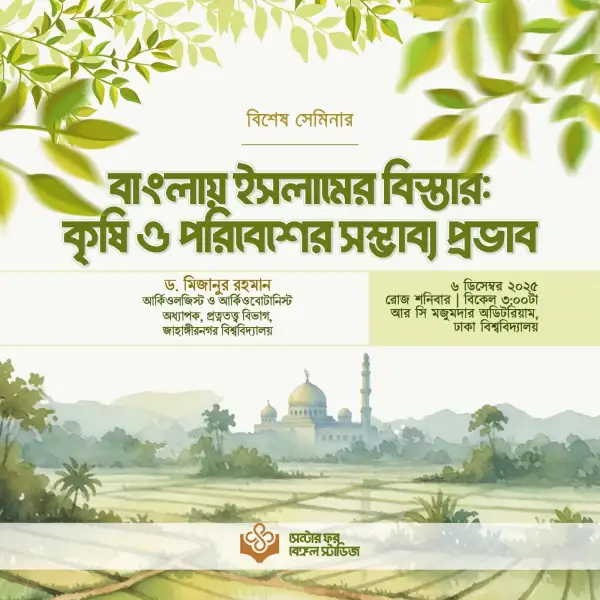
These observations were presented by Dr. Mizanur Rahman, Professor of Archaeology and archaeobotanist at Jahangirnagar University, during a seminar titled "The Spread of Islam in Bengal: The Potential Role of Agriculture and the Environment," organized by the Centre for Bengal Studies (CBS) at the R. C. Majumdar Auditorium of the University of Dhaka.
In his keynote address, Dr. Rahman argued that conventional narratives attributing the spread of Islam primarily to the sword or to mass conversion from a previously unified religion are open to question. He noted that there was no unified religious identity known as "Hinduism" during that period; rather, it emerged as a consolidated identity in the later colonial era.
Dr. Rahman identified agriculture as the principal factor behind the spread of Islam in Bengal. He explained that climate-induced changes in river courses and the emergence of new riverine lands (chars) created vast expanses of cultivable land during the medieval period. The establishment of Mughal military outposts, settlements, and agricultural activities in these newly cultivable areas also played an important role in the spread of Islam.
Other speakers at the seminar observed that the interrelationship between agriculture, the environment, and climate offers a new perspective for understanding Bengal's social history and provides an important foundation for future research.
Among those in attendance were Dr. Muhammad Alamgir, former Curator of the National Museum; Abdullah Al Mahmud, Executive Director of the Centre for Bengal Studies; as well as researchers, policymakers, and other distinguished guests.
Event Details
06 December, 2025
3:00 PM
RC Majumdar Auditorium, DU
Seminar